Disrupting Digital Monolingualism
This is the talk presented at the Disrupting Digital Monolingualism workshop at King’s College of London. The workshop was hosted by flagship project Language Acts and Worldmaking from June 16 to 17. This paper was presented as part of a panel centered around the discussion of monolingualism in the digital world, some challenges, suggestions, and ways forward. The reader can find the paper as well as images of the slides I used during the presentation.
Language and Technology Decolonization as a Disruption to Digital Monolingualism
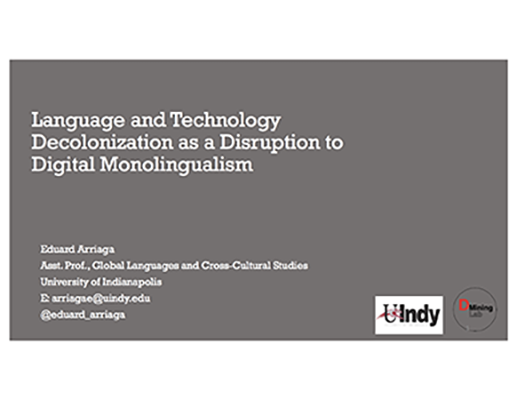
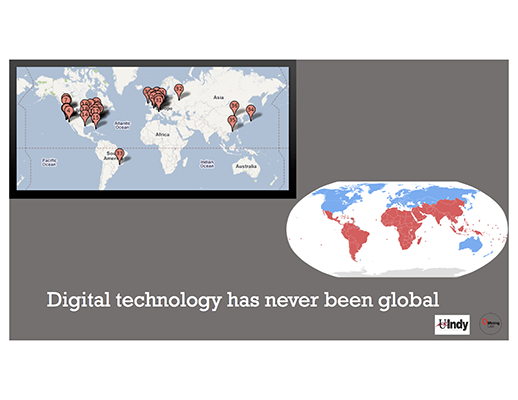
I’d like to start by going over some points of departure, so I can set the tone of my talk. First, digital technology in general and the internet in particular have never been global if by global we understand connected to most if not all location/communities on the globe. On the contrary, these technologies have been developed from and by centers related to imperial and colonial traditions, disseminated by algorithmic practices that shrink the world by overlooking differences, and are presented as free, open, and disembodied, so anyone, any culture, any language, any human being can use them.
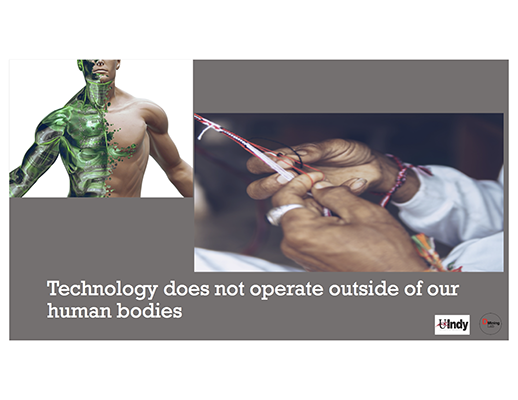
However, we tend to forget and misunderstand technology and its effects when we pretend they operate outside of human bodies and human relations. As Siva Vaidhyanathan (2018) would propose talking about digital media, “we are all embedded in the data network that would constitute the operative system of our lives”, meaning that if we want to understand the very networks and technologies we see as mere tools to achieve ends, we need to start looking at our deepest values on which such technological innovations are built. In summary technology is culture the same way as culture is a type of technology.
It is in that sense that I talk about the disruption of digital monolingualism considering, as proposed by the event organizers, 1) challenges, 2) ways forward, and 3) some suggestions as to who should be involved in proposing changes. All this will be done from the perspective of my research.
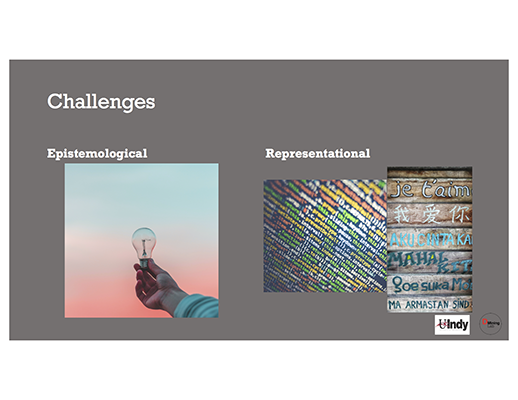
In terms of challenges, the main one is an epistemological challenge. This has to do with the conceptions of language and the digital from utilitarian perspectives. Institutions, students, and the society at large –at least in North America– see languages (particularly foreign languages) and digital technologies (from platforms used to extract and analyze data, to social networks and apps used to connect individuals) as mere tools that people need to master so they can go on and impose the sort of transactions they do to other latitudes, or develop extractivist dynamics (whether of meaning, raw materials, information, etc.) to bea pplied on human and non-human entities. Seen from this utilitarian perspective, some languages are “more useful” than others because they have more speakers, better status, more cultural and literary productions, and their associated cultures are, therefore, widely disseminated. The idea of landing jobs because of linguistic credentials becomes the driving force in learning other languages. Unfortunately, such learning process rarely entail immersing onself or even understanding the cultures where the target languages are spoken.
The second challenge, connected to the first one, has to do with the marginal position assigned to these languages –or even varieties of languages– that are not seen as useful (a representational challenge). Such marginality is, at the same time, coupled with the idea that these type of languages are spoken in marginal spaces where there is neither production of knowledge nor production of technology. This is directly connected to the conception of the digital and our imagination as to where the technology is produced. In our present case, technology and particularly digital technology is though as being developed in locations such as the US, the UK, China or Japan where English is either the primary language or the language with most status. Unfortunately, such imagination is not so off from the reality we currently live in. Although our technology is developed in diverse locations around the world, such locations are the result of a globalized culture that has Silicon Valley as its model. Some instances are Silicon Cape, Silicon Lagoon (in Africa), Brazilian Silicon Valley in Campignas, Zonamerica Uruguayan Silicon Valley (in South America), Haidian District (in China) Cyberport (in Hong Kong) among others. The replication of the American model entails a replication of values, languages, and uses of technology that creates a funnel cultural effect, in which diverse languages become subsumed to English as the basic language to produde knowledge, create technology and generate programming languages.
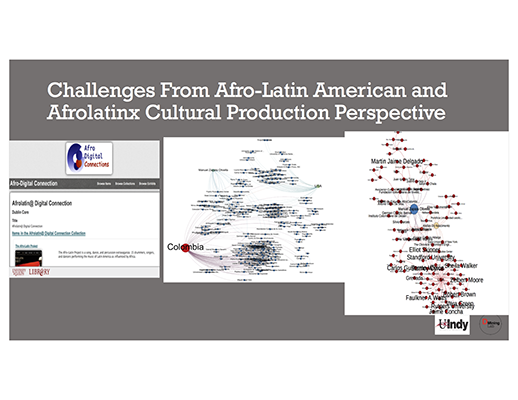
These two challenges translate to language teaching and research in the digital age. I use my research as case in point. My research revolves around Afro-Latin@ and Afro-Latin American Cultures, and their cultural production. In investigating the way these cultures are represented in the contemporary (20th-21st centuries) Hispanic world, I started to analyze literary pieces as fundamental type of data that would allow me to trace ontologies, question traditions, and understand the state of things at cultural, political and social levels. However, soon after I started with this research agenda, I realized several things:
-
There were few contemporary (20th and 21st Century) literary texts (when looking at literature as the main data source) created by or about Afro-descendant people in the Americas (particularly in the Hispanic World) that were digitized and ready to be analyzed through computational methods. (What do we actually digitize?)
-
Literature, understood as a canonical, privileged discourse, bounded to texts (seen basically as material books) was neither the preferred nor the only way these communities (Afro-Latin@ and Afro-Latin American authors, activists and practitioners) used to self-represent and to connect to other global communities. (Are digital tools designed for non-literate communities?)
-
Language and identity were not exclusively centered around the model of national identity and national boundaries, but in looking at diasporic formations, languages were in contact and therefore complex cultural, epistemological, political and social manifestations emerged.(What is teh conception of language that traverses the digital? How does such a conception exclude varieties as well as entire languages?)
This led me to be focused on a broader conception of Afro-Latin American and Afrolatinx cultural production; one that would go beyond the literary language and, instead, would be focused on digital-born/hybrid cultural productions. Such research agenda has allowed me to adopt even more interdisciplinary frameworks useful to travel from digital humanities frameworks to modern languages methodologies and the other way around. But this experience also allowed me to identify Afro-Latin American and Afrolatinx cultural productions as based on multilingualism; on languages, varieties of language, and codes that are constantly in contact and therefore are overlooked by linguistic research, language and literary/cultural teaching processes that are often interested in showing canonical documentation. In addition, as a researcher of cultural productions that are hybrid –developed in a combination of analog/digital— I have realized that the producers I have worked with, the Afrolatinx communities in Colombia, Brazil, the US, Puerto Rico, Dominican Republic, Costa Rica, Panama and so forth, re purpose digital technologies, data analysis techniques and digital platforms (as they have done in the past with colonial languages imposed on them) so they can showcase their epistemologies.
What can be done? What would be the way forward, so we can disrupt what the event organizers have called digital monolingualism –an extension of our cultural monlingualism or epistemological one dimensionality? My suggestions are as follows:
- Go beyond the utilitarian vision of language and technology to showcase how both are rooted in diverse traditions and worldviews. Both language and technology emerge from complex connections between our embodied experiences and our histories.
- Foster a decolonization of the digital translated as a re-adaptation of given technologies by communities whose languages, linguistic varieties, and epistemic actions can re-design the way those technologies are used. When his happens, their linguistic traditions will be at the center of technological innovation/experimentation
- Develop an expanded conception of infrastructure. This is meant to suggest a conception that goes beyond the mere physical spaces and digital gadgets, and that considers the interconnection between human beings, their cultural assets, and their knowledge, as well as existing social and cultural structures and any digital tools and digital networks that might already be in place. In that sense, an expanded infrastructure may be understood as set of processes and cultural interconnections in which existing structures (physical, symbolic, etc.), people as well as values and knowledge play a fundamental role.
Finally, all these ideas can only become real through an active participation of diverse agents, institutions and communities. In fact, when we speak about minority or marginal languages, we are talking about power relations that can be defeated through constant processes of solidarity and interconnection. In that sense, we would need active involvement of diverse agents such as:
- Technology experts from diverse linguistic communities that bring that linguistic background to the fore.
- Lirarians and archivist who work directly and in conjunction with minoritarian linguistic communities.
- Translators as connectors.
- Writers
- Cultural workers and agents
- Policy makers and government
- Educative institutions
- Interested communities
Thank you!
