Mining and Data Mining
Mining and (Data)Mining
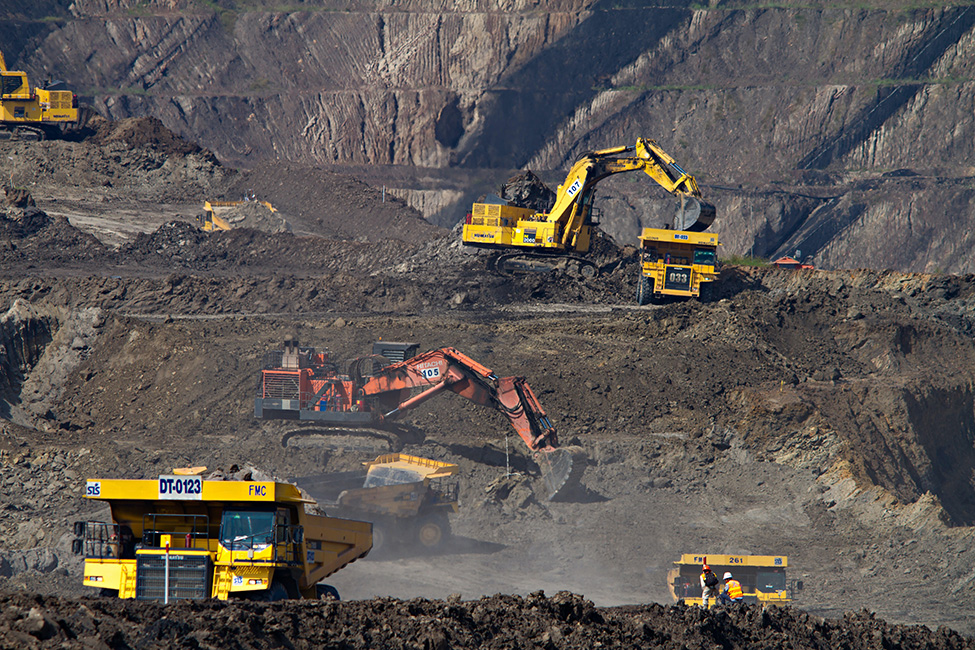
Extractive practices have been discussed largely as connected to colonial, imperialist, and capitalist projects that are seen as imposed on what has been termed the Global South. Such practices are continually linked to discussions of environmental sustainability and the conservation of particular territories, and are regarded as historical causes for the deterioration of environments that are understood as having been in balance before the dramatic changes created by centuries of colonization and exploitation of both bodies and non-renewable resources. Nevertheless, our current world is premised on economic growth and energy generation based in large part on the mining of such non-renewable resources. Technology, which has been presented as a magic cure to the impasse between growth and environmental sustainability, depends on large-scale industrial mining. These conditions create a paradox or aporia that has complex economic, social, human, and ecological implications at many scales, and that need to be addressed using a variety of approaches.
Our project examine some of these issues from the perspective of the arts and the digital humanities, paying particular attention to both the rhetorical power of the image and the political implications of Big Data. This project is conceived as a forum in which to explore the intersections between the material practice of mining and the supposedly virtual one of data mining. The domain of the digital, and particularly what is known as “Big Data,” has become a stage for different, and sometimes contradictory, goals used by a variety of actors, such as mining corporations, social movements, NGOs, and ethnic communities. Our project is designed to delve into these complexities and paradoxes to elicit questions that will, hopefully, open up constructive dialogues and courses of action.
Central to our group’s effort to ask questions and propose solutions is the process of examining and mapping the power of images as they are used to (mis)direct perceptions and debates on issues of public interest, such as the nature and scope of mining. We conceive the notion of “image” quite broadly, as a constellation of representational practices that includes not only visual objects, but also aggregations of literary, discursive, and data-based material that are used to construct narratives and bolster arguments. In our project, extractive mining and data mining are brought together to shed light on the displacement of wealth and labour value, and on the growing asymmetry between the people who create and control technology and those who own raw resources. The unbalanced emphasis given to data analysis and to the “accurate” or “truthful” representation of the world that it purports to construct has re-introduced a new paradigm of modernization and development in which the Global South is once again playing catch-up, even as the horizon to achieve such modernization seems to be moving ever farther from reach.
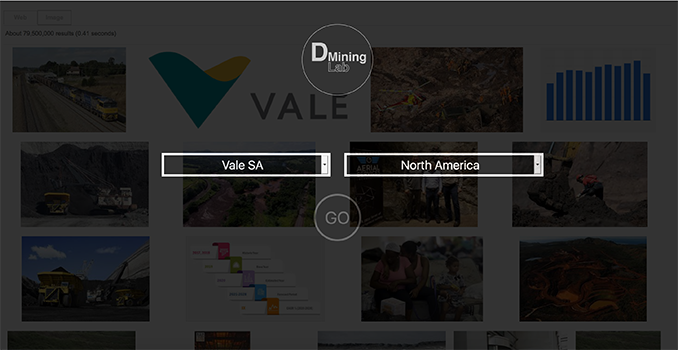
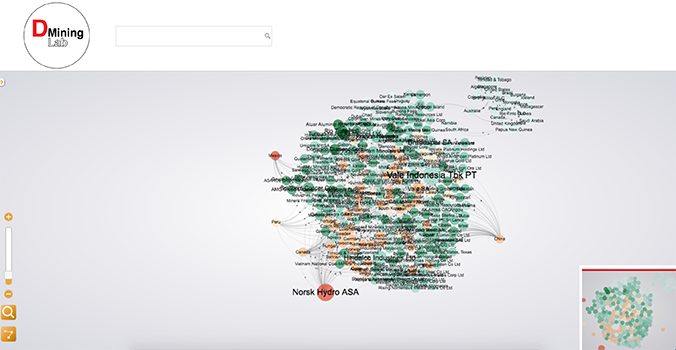
In that light, our project tests various methodologies that can be used for analyze, curate, and visualize large quantities of images. Our datasets were constructed using images related to mining in order to identify patterns and modes of representation associates with such images. These were collected from sources such as digital libraries and archives (the Internet Archive, the Critical Commons, the Smithsonian, etc.) and social media platforms (such as Facebook, Instagram, YouTube, etc.). The results of our experiments suggest that art and other creative practices can contribute insights to re-humanize both data-mining and extractive practices, stimulating, at the same time, social action to forge sustainable futures.
Through the use of digital tools as a way to investigate patterns and model large amounts of data’s behavior, our research seeks to draw attention to global unbalance in at least two important ways: on the one hand, we seek to “un-disclose” the rhetorical import of images, particularly those of Big Data, when they purport to express a particularly scientific (and hence objective) analysis of reality. We do not advocate a rejection of technology, but rather a critical use that adopts it to promote the buen vivir (good-ethical living) through the expansion of a virtual commons, as has been suggested by René Ramírez Gallegos in Ecuador. We feel it is important to address the imbalance in technology and in the knowledge it produces. On the other hand, the humanities have developed tools to study images in ways that have critical, material implications, which is important, since the desirability of extractive practices is bolstered in large part by the use of specific representations. Understanding how such representations are constructed, rather than taking them at face value, will move us further down the road towards an actual plurinational approach consistent with a buen vivir that uses environmental resources responsibly.